
Practicing In Actual
Want to stay proficient? Throw out the Foggles and spend some time in the soup. It'll do wonders for your confidence, not to mention your flying skills.
By Brian D. Johnson
Flying practice approaches under the hood or on a simulator is not the same as flying approaches in actual conditions. If the approach does not work out in the simulator, you can always hit the pause button, something not available in the airplane.
Simulated approaches under the hood with a safety pilot will help you hone your skills; however, it is difficult to simulate the degree of risk and uncertainty inherent in actual approaches. A creative instrument instructor can throw you a few curve balls and maybe even make you sweat, but in the back of your mind, it is impossible to forget that you are only under the hood and that it is severe clear outside the cockpit.
Simulated approaches may count towards instrument currency, but actual approaches provide invaluable experience that will enhance your IFR decision-making skills and your confidence.
Proficiency Flight
I typically fly frequently enough to stay IFR current based on actual approaches; however, occasionally I have to make more of an effort to do so. I had recently sold my Lancair 350 and transitioned to my G1000-equipped Cessna T182T, so I had not flown many actual approaches over the winter. A stationary front stalled over North Carolina and I decided to take advantage of the widespread IFR conditions. Icing and thunderstorms were not a factor, but there were pockets of rain throughout the state, especially at the coast. I planned a flight from Raleigh (KRDU) to Wilmington (KILM) and back and filed flight plans for both legs of the trip. Ceilings ranged from 500 to 1,000 feet, with visibilities between one and two miles - a perfect day to get more actual experience with the G1000.
The flight down to KILM was in solid IMC with periods of rain, but was otherwise uneventful. Unfortunately, XM weather was not available on the G1000 at the time (it should be available by the time you read this), so each rain shower was a surprise event. The Stormscope was clear, which prevented any unpleasant surprises.
The ATIS at KILM reported that the ILS to runway 35 was in use, but the surface winds were relatively strong out of the northeast, which favored runway 6. Since I needed multiple approaches and did not intend to land, I opted to go with the flow and asked for vectors to 35.
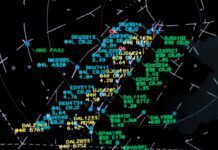
There were two other airplanes on the approach, so ATC assigned me an altitude of 1,800 feet and put me on an outbound vector, which paralleled the final approach course. The controller also assigned missed approach instructions to set up the next approach. I entered and activated the approach. The G1000 automatically inserted the localizer frequency into the active nav box and even identified it for me.
Due to the other traffic, the outbound vector was much longer than normal, which carried me farther and farther from the coast. I am not a big fan of flying over the ocean in a single-engine airplane, especially at only 1,800 feet. While I could not see the water below, my 10-inch MFD turned a brilliant shade of blue, which gave me something else to think about during the approach - an example of a distraction that you cannot replicate in the simulator.
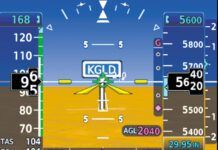
The controller eventually turned me toward the final approach course. Unlike the Nav-1 page of the Garmin 430, the G1000 does not display a CDI with a cross track (XTK) error. As a result, I had designated XTK as one of the custom user fields on the MFD. As I approached the final approach course and the XTK error counted down toward zero, I realized that I was going to fly through the final approach course.
I promptly queried the controller, who asked me if I had missed the final vector and approach clearance. That was unlikely, especially since I was especially interested in returning to dry land, but I also knew there was no upside in arguing with the controller. Besides, I had no interest in flying over Bermuda on my next vectored approach; I apologized for "my" mistake. The approach controller gave me a vector to intercept the final approach course from the opposite side of the final approach course and cleared me for the ILS.
I hand-flew the approach at 100 kts before breaking out in perfect position to land. I also hand-flew the second ILS at 100 kts with one notch of flaps - my standard precision descent configuration.
I generally like to hand-fly approaches and even feel a little guilty when I let the autopilot do all of the work. Hand-flying approaches is more difficult and I like the additional practice, especially in actual conditions. However, I also recognize that it is important to practice autopilot procedures regularly. Accordingly, I used the autopilot exclusively for the third ILS approach. I still used the same 100-kt pitch and power configuration. The only difference was that the autopilot navigated and controlled the pitch, while I managed the power. I completed the low approach and disconnected the autopilot to fly the missed approach.
On my next approach, the approach controller informed me that he would have to shorten my vector due to other traffic and I should expect a "close approach." Without my consent, the closest vector he could legally provide would be two miles outside the approach gate. To untie his hands, I asked for a vector inside the approach gate and offered to fly the approach at 140 kts - I was immediately very popular with the controller.
While we all want to be accommodating, we should not enter into decisions like this lightly. In this case, I already had a pre-determined pitch and power profile for a 140-kt precision approach. I am based at KRDU, a busy Class C airport, and I regularly use this profile to fit in with faster traffic. The primary challenge with this profile is slowing down sufficiently to land at the end of a low IFR approach. I did not plan to land, so the increased speed would not be an issue. Moreover, the increased airspeed would reduce the wind correction angle and provide better control response during the approach.
I was on my fourth consecutive ILS 35 approach, so I was obviously familiar with the procedure. However, the rain had persisted for the past hour and the ceiling and visibility had fluctuated on each approach. The final consideration was the glide path intercept point, which was located almost a mile outside the FAF. By accepting a vector inside the approach gate, I would have very little (if any) time to intercept the localizer, before descending on the glide slope. I hand flew the approach and it was a challenge, but that was the whole point of the flight.
Let's Make It Interesting
I wanted one more approach before returning to KRDU and I had explored every inch of the ILS; it was time for a new twist. I decided to take advantage of my improved standing with the controller and asked reverently if he had time for an ASR approach to 35. After a brief, contemplative silence, he agreed and assigned an initial heading and altitude.
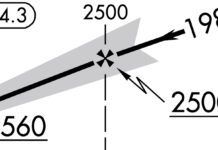
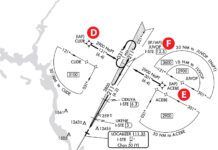
There are four ASR approaches at KILM, one to each runway. While NACO only provides ASR approach information in textual form, Jepessen depicts them on an approach chart which makes for much more familiar reading. The standard briefing strip is presented first, followed by the plan view with a depiction of the localizer front and back courses, the ILM VOR, and the LOM. The missed approach instructions and touchdown zone elevations for each runway are presented next, replacing the profile view. The minimums section is at the bottom of the page.
After briefing the approach and intercepting the assigned heading and altitude, I activated the ILS 35 approach on the G1000 for situational awareness. However, after some additional thought, I decided that would be too easy. I wanted to get the real feel for an ASR - the way I might experience one in an emergency.
I was not about to turn off my PFD in IMC, but I switched the localizer frequency from the active to the standby position and removed both the inset map and flight plan windows from the PFD. That eliminated all navigational and situational awareness tools from the PFD. The ILS approach course was still visible on the MFD if needed, but I vowed to focus exclusively on the PFD for the remainder of the approach.
If you have never done this in IMC, it is a very strange feeling: flying along in the rain and clouds when you can barely see your wing tips, no reference to moving maps or cockpit navigation - just a voice in the dark to guide you. It is truly flying blind.
The controller informed me that this would be a surveillance approach to runway 35 and the missed approach point was located one mile from the runway. I already knew that, but he was playing it by the book. He assigned me a new heading to intercept the final approach course, which was very similar to the vectors received on my previous ILS approaches. However, in this case, I could not monitor my progress. Shortly thereafter, he assigned me a new heading to track the final approach course. He then advised me "eight miles from the airport; prepare to descend in three miles; minimum descent altitude is 540 feet."
Every 15 seconds or so he would advise me of my position: "on course, on course, on course." Without these regular transmissions, it would get very quiet and lonely in the cockpit. He finally issued the descent instructions, "five miles from the airport, descend to your minimum descent altitude." I was flying at 100 kts, but this time I used the steeper non-precision descent profile to ensure that I reached the MDA prior to the missed approach point. The controller continued to report my position relative to the final approach course and my distance to the MAP. He also asked me to advise when I had the runway in sight.
I finally broke out of the clouds and the runway was visible at my 11 o'clock position. I was positioned to the right of the final approach course, but not by much and I was roughly a mile from the MAP. I was about to report the runway in sight, when the controller informed me that I was slightly right of course and issued a new heading to correct - these guys are good. The approach controller cleared me for the option and I executed the assigned missed approach instructions and picked up my clearance back to Raleigh.
I had always marveled at the sight of the runway appearing as if by magic at the end of an ILS approach. By comparison, breaking out after an ASR approach is truly astonishing. One minute you are simply holding headings and altitudes, with no navigational or visual references, the next you are lined up to land on the runway.
On my way back to KRDU, I asked the controller for a hold at a convenient intersection along my route. Since this was my request, I also specified the cardinal direction, the bearing to the waypoint, the direction of turns, the length of the legs and the EFC time. You can probably guess the resulting holding pattern entry. I finished up with one last 140-kt ILS approach at KRDU.
It was a good IFR workout: three hours of flying, with 2.5 hours in the clouds, six approaches, including one ASR approach and holding procedures. The experience of flying an actual ASR approach would be priceless in the event of a real emergency. When things go very wrong, having a controller guide you all the way to the runway is the epitome of CRM. However, while the ASR is not a difficult approach to fly, it is unusual. You would not want to experience your first actual ASR approach in a crisis. The balance of my proficiency flight was not overly difficult, but every IFR flight requires a series of decisions.
Controllers, weather, traffic and aircraft systems are all variables that interact together to make each flight a unique challenge. Meeting these real world challenges will expand your experience in IMC and refine your IFR decision-making skills.
Brian D. Johnson is a CFI, CFII and MEI who flies a G1000-equipped Cessna T182T out of Raleigh-Durham International Airport (KRDU), N.C.